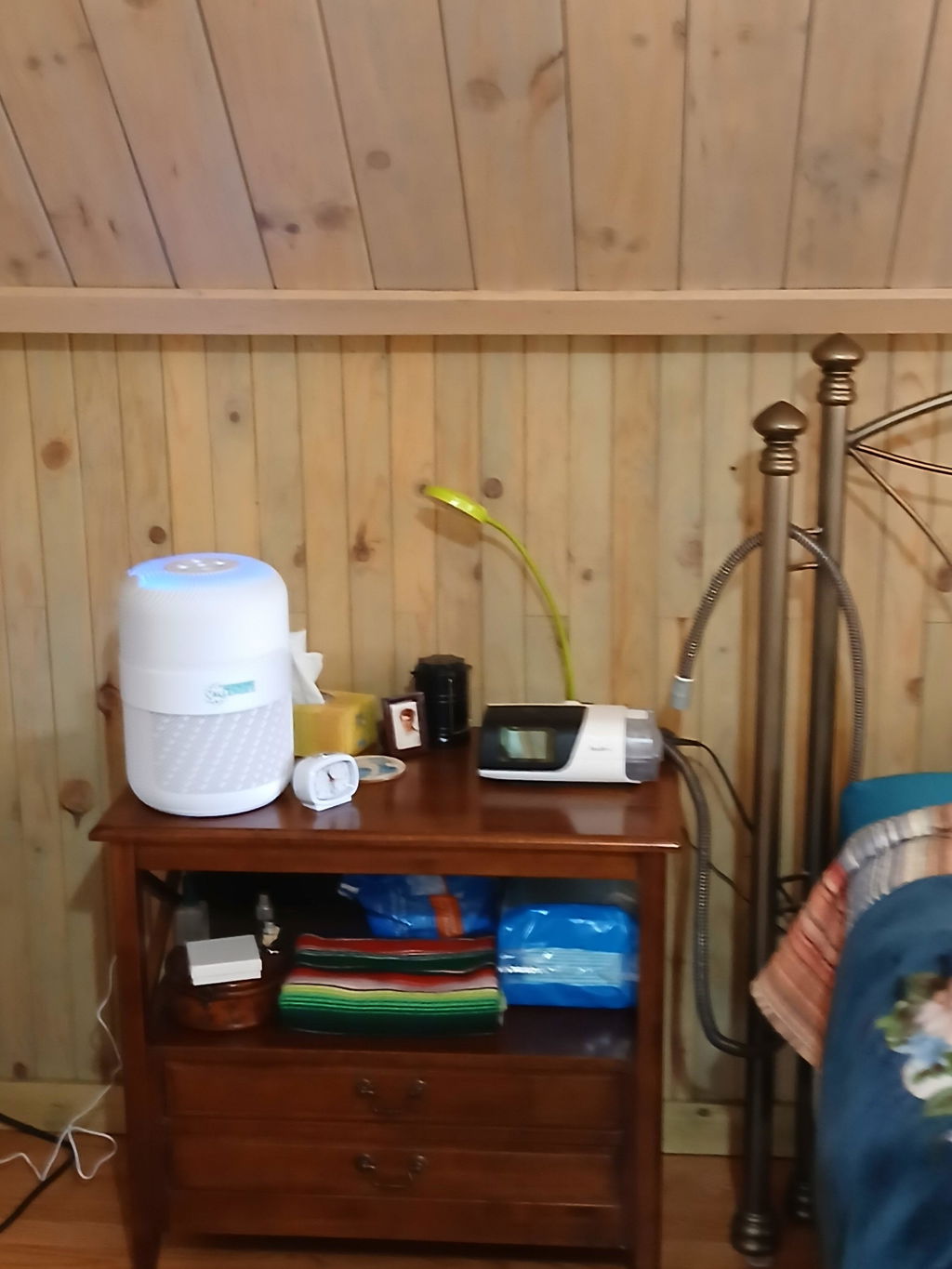
P1211 Air Purifier with Medical Grade HEPA Filter

Regular price $250.00 Sale price$212.50
/
Shipping calculated at checkout.
  • 3-year warranty
  • Free shipping and returns
  • Canadian Company
  • Delivery 1-6 working days
  • 30-day satisfaction guarantee

Improve your health by breathing better air

Ideal for your small office or bedroom

Processes 120 m³ of air per hour (CADR) (the important criterion to look at, not surface area)

3 fan speed grades

Recommended surface area: 215 square feet or 20 square meters (processing air in 30 minutes)

Sleep better at night

3 purification steps

1. Pre-filter : Removes particles easily visible to the eye, such as dust, hair and pet dander.

2. HEPA 13 filter : Removes 99.97% of all particles larger than 0.3 microns, such as bacteria, mold spores, dust mites and pollen.

3. High-density activated carbon filter : Absorbs volatile organic compounds such as second-hand smoke and various types of pollutant gases.

Enjoy life better

Noise level: less than 35 dB

Product dimensions: 24.2 * 24.2 * 31 cm

Weight: 1.5 kg

Air quality indication from blue; best quality to red; serious contamination

Features aromatherapy

Filters included. You can order replacement filters here

Recommended by Allergists with its true medical HEPA filter

ETL-certified for safety and performance

We recommend changing the filter 1-2 times a year, and 2-6 times if you smoke.

This site is protected by hCaptcha and the hCaptcha Privacy Policy and Terms of Service apply.

Marie Soleil presents the P1211 air purifier

Frequently asked questions

📌 Yes - because it uses a medical-grade HEPA filter (H13) that captures 99.97% of particles ≥ 0.3 µm, including: pollen, dust, dust mites, pet dander

→ These are often asthma or allergy triggers.

Also, its good-density activated carbon filter helps reduce certain gases and odors that can irritate the respiratory tract

→ This combination is recommended for asthma and allergies.

👉 For asthma, it's not just the quality of the filter that counts, but also the treatment of the room's air volume.

Respiratory health guides generally recommend adapting the purifier to the size of the room: a device that's too small won't remove particles fast enough in a large space.

✔ Place it in the room where asthmatics spend most of their time (e.g. bedroom)

✔ Run it continuously for best results

✔ Clean/replace filters according to manufacturer's recommendations

👉 For a large room, it may be worth considering a model with a higher CADR, such as the purificateur P3001 or the purificateur P6006.

A P1211 in the bedroom and a P3001 or P6006 in the living room would be ideal.

We recommend that you leave your P1211 air purifier in AUTO mode and forget about it! Its PM2.5 particle sensor detects the tiniest variations in air quality and automatically adjusts its speed accordingly.

1 Yes, the P1211 purifier reduces viral particles in the air

SARS-CoV-2 (Covid-19 virus) circulates in the air via aerosols and micro-droplets ranging in size from 0.1 µm to several microns.

👉 Its HEPA 13 filter captures 99.97% of particles ≥ 0.3 microns, and very effectively filters respiratory aerosols, which are larger than the isolated virus.

So, yes, the P1211 will:

✔️ reduce the concentration of viral particles in the air

✔️ reduce the risk of exposure as a complement to other measures

But it must

✔️ Have sufficient CADR

The Clean Air Delivery Rate must be adapted to the size of the room to stir the air 4 to 5 times an hour, and a minimum CADR of 100 for a room as possessed by P1211 is recommended.

✔️ be well placed

✔️ run continuously

For maximum efficiency, we recommend the P1211 in your bedroom and a purifier P3001 or purifier P6006 in the living room.

Yes - the HEPA H13 filter (like the P1211) is effective against pet hair, but with one important nuance.

🐶 Pet hair: how does it really work?

✔️ What HEPA H13 does well

  • Pet-related hair, dander, allergens and fine dust are captured very well
  • Microscopic allergens (those that cause allergies) are 99.95% trapped

👉 For pet allergies, this is very effective.

⚠️ What you absolutely need

The hairs themselves are large → they must be stopped BEFORE the HEPA.

➡️ A pre-filter is essential.

  • It captures visible hairs
  • It prevents the HEPA from clogging up too quickly
  • greatly extends filter life

Without a pre-filter, the HEPA quickly becomes saturated.

🔎 So, is the P1211 suitable?

Yes, because it has a pre-filter as well as an H13 HEPA filter.

An H13 HEPA filter is a very high-efficiency filter. Here's a clear, comparative explanation of how it compares to other filters.

🔍 What is a HEPA H13 filter?

According to European standard EN 1822:

  • A HEPA H13 filter retains at least 99.95% of particles 0.3 micrometers (µm) in size.
  • It acts on the most difficult particles to capture (known as MPPS)

It is considered a "high-end" standard for air purification.

🧱 Comparison with other filter types

🟢 1. Pre-filters (coarse)

  • Holds: visible dust, hair, bristles
  • Efficiency: low
  • 👉 Protect HEPA, but don't really purify the air

🟡 2. Fine/pollen filters (G, M, F - old standard)

  • Holds: pollen, coarse particles
  • Efficiency: average
  • 👉 Insufficient for viruses, fine particles, pollution

🟠 3. HEPA filters (E10 - E12)

  • Efficiency: 85% to 99.5
  • Retain: fine dust, allergens
  • 👉 Good, but not HEPA-level

🔵 4. HEPA H13 (very high efficiency)

  • 99.95% efficiency
  • Contains : PM2.5 / PM0.3, Allergens, Bacteria, Viruses (via aerosols)
  • 👉 Excellent compromise between performance, cost and airflow

🟣 5. Activated carbon filter (complement)

⚠️ Not a HEPA filter

  • Contains: odors, gases, VOCs, fumes
  • 👉 To be combined with a HEPA H13, not to be replaced

⏳ Average life of a HEPA H13 filter

👉 6 to 12 months in most cases.

📌 How long does it last?

🌫️ Air quality

  • Urban air / pollution / smoke → 6 months
  • Clean air (countryside, little pollution) → up to 12 months

🏠 Usage

  • 24-hour operation → faster wear
  • Occasional use → longer life

🐶 Environment

  • Animals, dust, pollen → faster saturation
  • Smokers → more frequent replacement

🧹 Pre-filter

Roughly speaking, we recommend changing 1 to 2 times a year, and if you're a smoker 2 to 6 times a year.

No, the P1211 purifier does not emit ozone.

10 benefits of an air purifier

Air purifiers have become essential appliances in many homes and work environments, offering an effective solution for improving indoor air quality. Their use offers a multitude of benefits that go beyond simply filtering out airborne particles. Here are ten key benefits of having an air purifier:

1. Allergen reduction

Air purifiers are particularly effective at eliminating allergens such as pollen, animal dander and dust mites, which can trigger allergic reactions in some people. The HEPA (High Efficiency Particulate Air) filters used in many purifiers are designed to capture the microscopic particles responsible for allergies.

2. Pollutant removal

Air purifiers are able to filter out various indoor air pollutants such as harmful gases (like carbon monoxide), volatile organic compounds (VOCs) from household chemicals and building materials, and tobacco smoke. This helps maintain a healthier, safer environment for occupants.

3. Improved respiratory health

By reducing the concentration of fine particles and other irritants in the air, air purifiers help prevent respiratory problems such as asthma, bronchitis and other lung diseases. For people suffering from these conditions, purified indoor air can significantly improve their quality of life and reduce the frequency of symptoms.

4. Odor neutralization

Some air purifiers feature activated carbon filters that absorb and eliminate unwanted odors from cooking, pets, tobacco and other sources. This helps maintain a fresh, pleasant indoor environment.

5. Reducing the spread of disease

By eliminating airborne pathogens such as viruses and bacteria, air purifiers help reduce the risk of spreading infectious diseases within a home or office. This is particularly beneficial in environments where several people regularly rub shoulders.

6. Protection against the effects of passive smoking

For homes where there are smokers, or in public spaces where smoking is permitted, air purifiers play a crucial role in removing tobacco smoke particles and thus reducing exposure to passive smoking, which can cause serious health problems for non-smokers.

7. Improved sleep

Breathing purified air at night can promote better quality sleep. People suffering from sleep apnea, snoring or other respiratory disorders can benefit from an indoor environment free from pollutants that could aggravate their symptoms.

8. Increased productivity

In working environments, clean, healthy indoor air can contribute to better concentration, greater mental clarity and reduced fatigue. This can translate into increased employee productivity and reduced absenteeism due to health problems.

9. Furniture and object preservation

Fine particles and gases in indoor air can gradually damage furniture, textiles and other precious objects. An air purifier reduces this deterioration by filtering out pollutants that could cause long-term damage.

10. Support for sensitive environments

People living in sensitive environments such as hospitals, nurseries or retirement homes benefit greatly from air purifiers to maintain optimal sanitary conditions and reduce the risk of nosocomial infections or complications among residents.

In conclusion, air purifiers offer a diverse range of benefits, from improved health to property preservation and increased day-to-day comfort. Investing in an air purifier tailored to the specific needs of your space can not only improve your quality of life, but also help create a safer, more pleasant indoor environment for yourself, your family and your colleagues.